
Case Study
Rebuilding a Welsh Coastal Holiday Park Website for Search Visibility, AI Discovery and More Enquiries
Services
Client: Rhinog Park
Location: Dyffryn Ardudwy, Eryri, Wales
Sector: Holiday Parks / Tourism / Holiday Home Ownership
Project: Website Redesign, Development and Migration
The Challenge
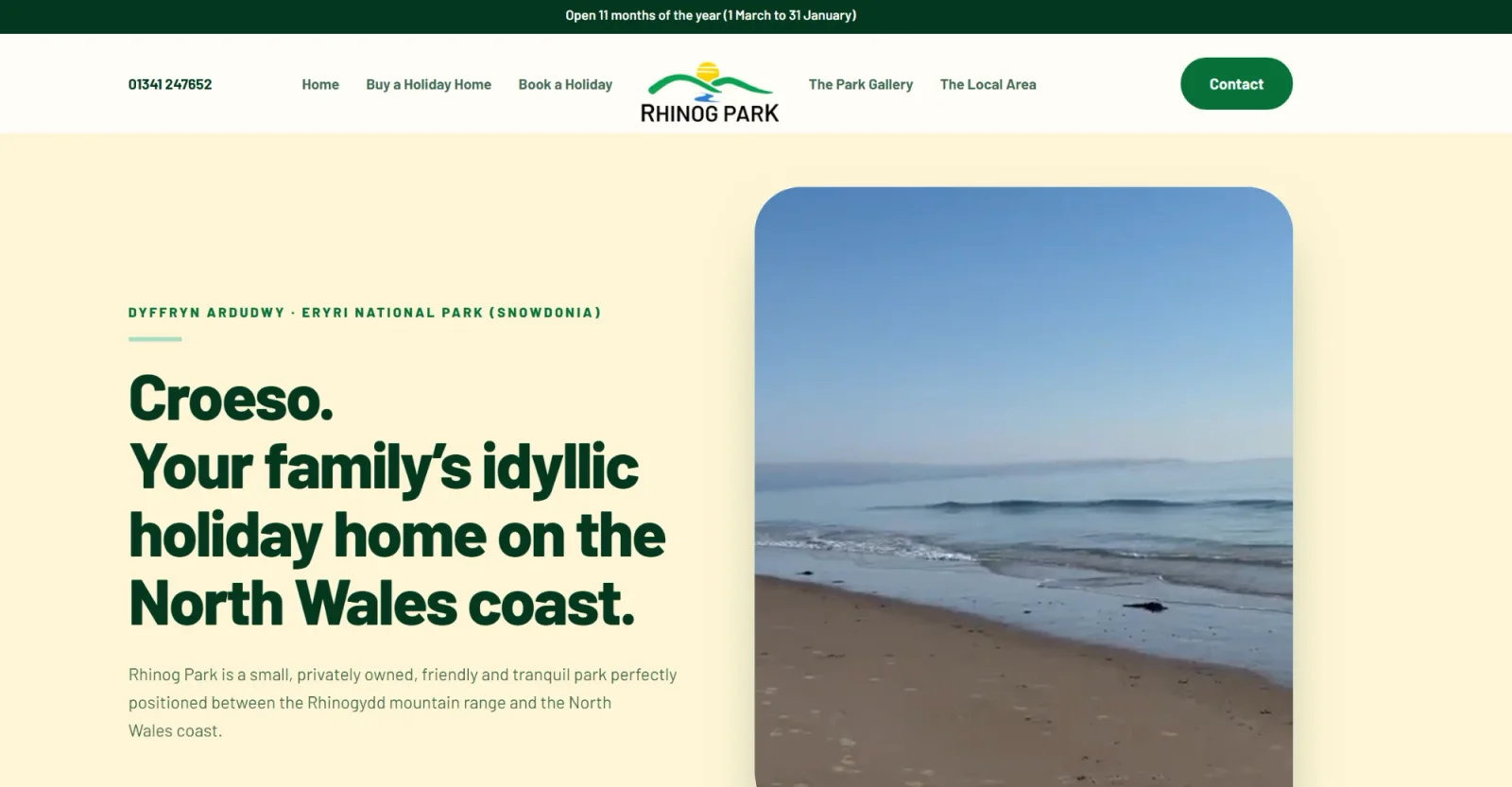
Rhinog Park is a small, family-run holiday park in Dyffryn Ardudwy, on the beautiful coastline between the Rhinogydd mountains and Cardigan Bay.
The park offers self-catering lodge holidays and holiday home ownership, attracting visitors looking to explore this part of Wales or establish their own holiday retreat.
For Rhinog Park, the website is an important part of the customer journey. Whether someone is researching a coastal break or considering buying a holiday home, that journey will often begin with an online search and develop into an enquiry.
But the park's ageing WordPress website was no longer providing the digital foundation the business needed. The brief focused on three priorities:
- Generate more relevant holiday and holiday home ownership enquiries.
- Improve visibility in traditional search engines and emerging AI-assisted search experiences.
- Give the park's team the ability to manage its own website content without relying on a developer.
The third requirement was particularly important. The team had previously wanted to remove photographs from the website gallery, but the process required external assistance, so the updates had not been made. This highlighted a common problem with business websites: when a business cannot easily update its own website, the content gradually becomes less accurate and less useful. Rhinog Park needed a website that could evolve alongside the business.
Our Approach
We approached the project as a complete website and content architecture rebuild rather than a straightforward redesign. The objective was to create a website that worked for three audiences:
- Visitors needed clear information about the park, its accommodation, holiday homes and facilities.
- Search engines needed an accurate, structured understanding of the business and its individual pages.
- AI-assisted search systems needed accessible, well-organised content that could be interpreted and referenced appropriately.
Alongside these requirements, the website needed a practical content-management system that the park's own team could operate confidently. We began with a detailed audit of the existing website before designing the replacement architecture. That decision proved important, because the audit uncovered problems that went well beyond the appearance of the old website.
Services Delivered
Website Strategy and Design. Rebuilding the website around holiday accommodation, holiday home ownership, visitor information and enquiry journeys.
Technical SEO. Improving page structure, metadata, internal linking, structured data and search engine accessibility through technical SEO.
AI Search Optimisation. Organising content into clear, machine-readable information and configuring access for relevant AI crawlers, part of our approach to AI search and answer engine optimisation.
Website Migration. Auditing 62 existing URLs and implementing a deliberate website migration strategy to preserve useful content while removing irrelevant pages.
Content Management Development. Creating editable page templates and structured collections so the park's team can manage content, galleries and holiday homes.
Performance and Accessibility Optimisation. Improving mobile loading performance, visual stability, contrast and semantic page structure.
Enquiry Tracking and Analytics. Building the foundations for measuring enquiries, booking journeys and search performance with analytics.
The Website Audit: Finding Problems Hidden in Plain Sight
Before rebuilding the website, we examined its existing sitemap and tested every URL listed. There were 62 URLs. The audit revealed that 24 of those pages should not have been publicly available.
Demonstration content indexed by search engines
Fourteen URLs contained demonstration content left behind by the website's original WordPress theme. These included a staff page featuring people who did not work at the park, and a services page referring to swimming pool facilities that Rhinog Park does not have. This content had remained accessible and indexed.
For a tourism business, inaccurate information is more than an untidy website issue. Someone researching a holiday park needs to be able to trust what they read about its facilities. Search engines and AI systems also depend on the information available to them. If that information is inaccurate, the business risks being represented incorrectly.
Unnecessary WordPress attachment pages
The audit also identified ten WordPress attachment pages. These were individual URLs automatically generated for uploaded images, each containing little more than a single photograph. They offered little standalone value to visitors and unnecessarily increased the number of pages search engines needed to process.
The audit gave us a clear picture of what should be retained, what needed replacing and what should disappear entirely. A successful website migration starts by understanding the existing website, not simply copying its URLs into a new system.
Building a Website That Search Engines Can Understand
The new Rhinog Park website was developed with technical SEO built into its structure. Rather than treating structured data as an optional addition, we used it to describe the business and its content consistently. The implementation includes relevant schema types such as Organization, LocalBusiness, Campground, WebSite, BreadcrumbList, FAQPage, HowTo and ItemList.
These help describe the relationship between the park, its location, its facilities and the information presented on individual pages. The business information includes address and geographical coordinates, contact telephone number, opening season, areas served, awards, visitor facilities, dog-friendly information and electric vehicle charging information.
This creates a clearer, more consistent description of Rhinog Park for systems that consume structured website data. It also reduces the risk of important business information being interpreted inconsistently across different pages.
Preparing for AI-Assisted Search
One of Rhinog Park's specific requests was to improve its visibility in AI search. That required a practical approach. No agency can guarantee that an AI assistant will recommend or quote a particular website. What we can do is make the information accurate, accessible, clearly structured and easier for compatible systems to interpret. This is the heart of answer engine optimisation.
Clear answers to real visitor questions
The website includes 21 questions and answers, with the answers presented visibly to visitors as well as represented in structured data. Machine-readable information should reflect the content people can actually see. The questions help visitors understand practical details about the park and provide concise information that search systems can interpret.
Explicit AI crawler configuration
The website's crawler configuration explicitly permits access for named AI-related crawlers and services, including GPTBot, OAI-SearchBot, ChatGPT-User, PerplexityBot, ClaudeBot, Google-Extended and Applebot-Extended. This makes the park's preferences clear rather than relying entirely on default crawler behaviour. Allowing access does not guarantee indexing, retrieval or inclusion in AI-generated answers, but it removes one potential barrier to discovery.
Consistent, machine-readable business information
The website provides structured information about what Rhinog Park offers and where it is located. This gives traditional search engines and compatible AI-assisted systems a more reliable source of information about the business. The objective is to make Rhinog Park easier to discover and accurately describe when people research holidays or holiday home ownership in the area.
A Carefully Managed Website Migration
Website migrations carry real SEO risks. Existing pages may have earned links, search visibility and recognition over several years. If those URLs disappear without a plan, visitors and search engines can lose their route to the content. For Rhinog Park, we audited and tested all 62 existing URLs individually. The final migration strategy was deliberate.
12 URLs retained. Pages that could keep their existing addresses were preserved, which minimised unnecessary changes to established routes.
26 URLs permanently redirected. Pages that had moved were redirected to the closest relevant replacement. These included holiday lodge pages, caravan pages, previous booking routes and individual guest review pages, helping visitors following older links reach the information they intended to find.
24 URLs removed intentionally. The remaining URLs consisted of irrelevant theme demonstration content and unnecessary attachment pages. These were deliberately allowed to disappear rather than being redirected to unrelated pages. Redirecting every obsolete URL to the homepage might appear convenient, but it can create a poor visitor experience and be interpreted as a soft 404 by search engines. Knowing which URLs not to redirect is just as important as knowing which ones to preserve.
The migration was supported by 36 redirect rules, with each legacy URL tested to ensure its outcome was intentional. This is the level of care we bring to website migration and systems integration.
Giving Rhinog Park Control of Its Own Website
One of the most commercially important improvements was the new content-management experience. The park's team wanted to be able to update information and photography without asking a developer to make routine changes, so we built the content-management system around that requirement.
The platform includes 9 content collections and 9 editable page templates. The park's team can now edit page text, replace photographs, add and remove gallery images, reorder gallery content, update holiday homes available for sale and maintain key visitor information. This gives the business greater independence, and makes it more likely that the website will remain accurate as accommodation availability, photographs and park information change.
The objective was not simply to provide a CMS. It was to provide a CMS that the people running the park could genuinely use.
Managing Important Documents Properly
The website also needed to accommodate four contractual documents, which required more careful handling than ordinary marketing content. The owners' park rules, for example, contain 18 sections and 58 numbered clauses, and preserving that structure matters. A numbered clause may need to be referenced during a discussion or dispute, so the document must remain clear and consistent.
We built the documents into the content-management system while retaining their numbering and structure. Each document also includes its own version and date. An additional safeguard prevents accidentally emptied fields from creating incomplete public documents: if required content is removed unintentionally, the published page falls back to the last known complete version rather than displaying a contract with missing sections. This is a good example of how content-management requirements can become a question of business process and risk management, not just website editing.
Improving the Booking Experience Without Slowing Down the Website
Rhinog Park already used a third-party booking engine. There was no need to replace a working booking system simply because the website was being rebuilt, so we focused on integrating it more efficiently. Previously, the booking engine loaded across pages whether visitors needed it or not. On the new website, the booking integration loads only when a visitor scrolls to the relevant area. This reduces unnecessary work during the initial page load and avoids imposing the booking engine's resource cost on visitors who are simply browsing information.
It is a small architectural decision with practical performance benefits. The wider principle is important: keep the systems that work, but integrate them in a way that supports the experience rather than slowing it down.
Performance Built Around Mobile Visitors
Tourism websites need to work well for people browsing on mobile devices, whether they are researching accommodation while travelling, comparing destinations or looking for information during their stay. We therefore tested the rebuilt website using mobile Lighthouse conditions. The launch measurements were:
| Lighthouse metric | Result |
|---|---|
| SEO | 100 |
| Performance | 88 |
| Accessibility | 93 |
| Largest Contentful Paint | 2.5 seconds |
| Cumulative Layout Shift | 0 |
| Measured server response | 30 milliseconds |
These are laboratory measurements from the supplied test, rather than ongoing real-user performance data. The results demonstrate a strong technical foundation. A Cumulative Layout Shift score of zero is particularly useful for mobile visitors, because it means the measured page layout remained stable as it loaded. This helps prevent text, buttons and other elements moving unexpectedly while someone is trying to interact with the page.
Accessibility Improvements That Also Help Machines Understand the Page
The performance and accessibility review identified two specific issues.
Improving text contrast. Some footer text had a contrast ratio of approximately 2.5:1 against its background, below the commonly required 4.5:1 threshold for normal-sized text under WCAG AA. We corrected the styling, bringing the relevant contrast ratios to approximately 4.9:1 and 6.5:1, which makes the footer information easier to read.
Correcting semantic HTML. The audit also identified a malformed definition list on the homepage. Although the issue was not visually obvious, it affected the page's accessibility tree. We corrected the markup so assistive technologies could interpret the content more reliably. Well-structured semantic HTML can also help automated systems understand the relationships between elements on a page.
This reinforces an important point: accessibility, technical SEO and machine-readable content often benefit from the same underlying development discipline.
Building a Foundation for Measurable Enquiries
The ultimate objective of the project is to generate more enquiries, for both holiday accommodation and holiday home ownership. The website had not been live long enough at the time of this case study to make reliable claims about increases in either. Rather than invent results, we built the platform so those outcomes can be measured.
- Enquiry recording. Website enquiries are recorded in the park's own database as well as being delivered by email, creating a more reliable record of enquiry volumes.
- Booking journey measurement. Analytics have been configured to follow relevant visitor journeys through to the existing booking engine, providing a foundation for understanding how website visits contribute to bookings.
- Search performance monitoring. Google Search Console can be used to monitor impressions, organic clicks, queries, newly appearing search terms and the performance of individual pages.
Over time, this will help the park understand which content is generating visibility and which journeys are producing enquiries. The website was built not just to attract visitors, but to make its commercial performance easier to understand.
Results and Impact
At launch, Rhinog Park had a significantly stronger digital platform with measurable improvements in structure, maintainability and technical quality:
- 21 pages built, with 16 included in the XML sitemap.
- 62 legacy URLs audited, every existing URL tested individually to support a controlled migration.
- 36 redirect rules, preserving relevant content routes while removing unnecessary pages.
- 21 visible questions and answers, supported by corresponding structured data.
- 9 content collections and 9 editable templates, giving the park greater control over its website.
- 100 Lighthouse SEO score in the supplied mobile test.
- 0 layout shift, a stable page layout in the measured test.
- Enquiry tracking foundations, with database-backed enquiry recording and booking journey measurement configured for future reporting.
These are the confirmed technical and operational results. The longer-term commercial outcomes, including organic visibility, enquiries and bookings, will be assessed once sufficient post-launch data is available.
What This Demonstrates
The Rhinog Park project demonstrates The DM Lab's ability to combine website strategy, website design and development, technical SEO and AI search optimisation, structured data, website migration, content management architecture, performance optimisation, accessibility, third-party booking integration, and analytics and enquiry tracking into a connected digital platform.
It also demonstrates that a successful website rebuild is not just about launching new pages. It requires understanding the existing content, protecting valuable URLs, removing inaccuracies, making the new platform maintainable and creating a way to measure business outcomes. This is the thinking behind our solutions architecture services.
Final Thought
Rhinog Park needed a website that could do three things well: help people discover the park, turn that interest into enquiries, and give the people running the business control over the content. The rebuild addressed all three.
We replaced an ageing WordPress website with a structured, mobile-friendly platform, removed inaccurate legacy content, carefully managed the migration of 62 URLs and introduced a content-management system the park can operate independently. We also made the website easier for traditional search engines and compatible AI-assisted systems to interpret, without making unrealistic promises about search rankings or AI recommendations. If you are weighing up a rebuild of your own, our guide on signs your business website needs rebuilding is a good place to start.
The result is a stronger digital foundation for a family-run holiday park in one of Wales's most distinctive coastal locations. A good website should be easy to find, easy to use, easy to maintain and capable of demonstrating the value it brings to the business. That is what we set out to build for Rhinog Park.
Explore our solutions architecture services, learn more about our SEO services, or discover our website migration services. When you are ready, speak to The DM Lab.
Service behind this project: Solutions Architecture →
Related case studies

Rebuilding a Property & Asset Management Website for Performance, Search Visibility and Growth
Website Design | Next.js Development | SEO & AEO | Recruitment Functionality | Digital Platform Development Website: https://www.gbhereford.co.uk/ The Challenge GB Group is a property and asset management contractor delivering repairs, planned maintenance and wider property services for housing providers, government and private-sector clients.

Bringing a Heritage Legal Practice into the Mortimers Family Online
Website Design | Static Website Development | Content Migration | Technical SEO | Hosting & Deployment Client: Lewis Lines & Wilkes Solicitors Location: Brynmawr, Wales Sector: Legal Services / Professional Services Website: https://www.

Building a Digital Platform to Transform Grassroots Sports Officiating
Solutions Architecture | SaaS Development | Platform Design | Stripe Integration | Mobile App Development Website: https://findmearef.co.uk/ The Challenge Grassroots sport depends on volunteer officials, yet the process of appointing, managing and paying referees often relies on outdated systems.
Want results like this?
Tell us about your project and we'll show you how we can help.